Start from the product family
The product has to be assessed under a certification system with health, quality, or interior-product criteria.
 Build estimate
Interior material certification
This page turns the PDF certificate row into buyer education: what the catalog shows, how hard the evidence is to obtain, what to verify before purchase, and why ADU Cost is different from a badge-only sales page.
What the PDF shows
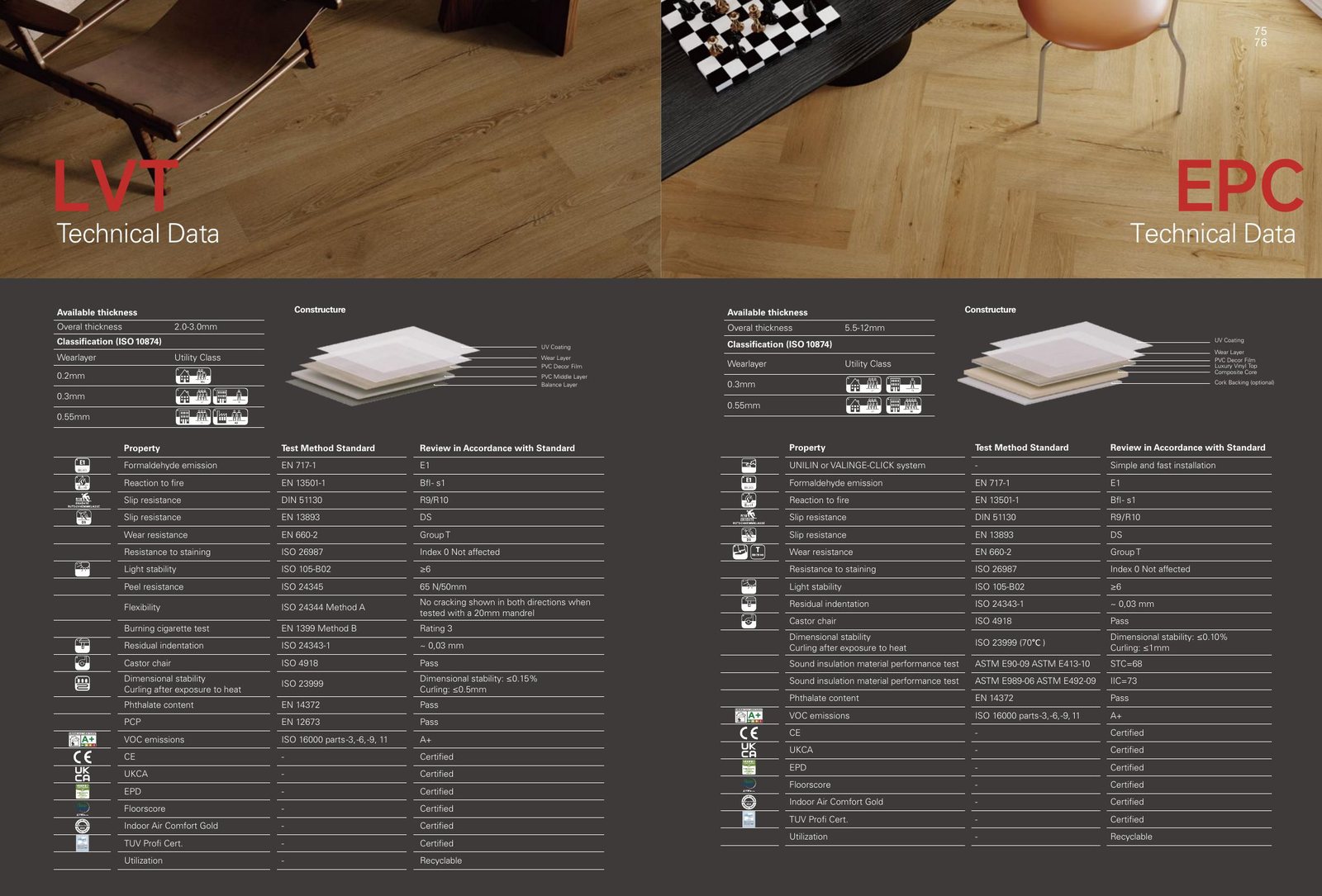
The Kingdom flooring PDF includes TUV Profi Cert in the certificate table for the LVT/EPC product families. It is listed as a finish-material claim, not as a California state approval.
TUV Hessen describes TUV PROFiCERT as a conformity assessment brand. Related interior-product allocation criteria describe interior products such as flooring, wall coverings, ceiling coverings, underlays, and adhesives.
The important wording is disciplined: ADU Cost can say the supplied PDF catalog lists this evidence for the relevant material family. ADU Cost should not say every future unit, every color, every batch, every wall panel, every adhesive, or every installed ADU has this certification unless the current certificate or test report is supplied for the exact selected material. That is the difference between strong proof language and a risky badge wall.
Interior material certification can strengthen the finish story when the buyer wants more than a visual sample. It helps show that the seller is asking for product-level evidence around interior products, not only choosing attractive surfaces.
PDF evidence snapshot
How hard is it?
The sales page should help buyers understand the effort behind the mark or test result. A certificate line in a catalog may represent real testing, third-party review, factory controls, declarations, emission chambers, performance samples, or market-access documentation. But the work only protects the buyer when the current document is tied back to the exact finish package being quoted.
The product has to be assessed under a certification system with health, quality, or interior-product criteria.
The certificate scope has to name the product category and holder clearly enough for procurement to match it.
If flooring, wall panels, adhesive, and underlayment are different product families, one certificate may not cover all of them.
Request the current TUV PROFiCERT or TUV Interior certificate for the exact flooring family.
Check issuing body, holder, product scope, valid period, and whether installation accessories are included.
Treat the row as support for finish due diligence, not as proof of local building approval.
Buyer article
A modular ADU buyer usually starts with the picture, the floor plan, and the total number. The better sales conversation adds a fourth layer: evidence. This certificate page helps the buyer see that the finish package is not just a style choice. It is a documentation choice that can affect indoor-air confidence, durability expectations, resale files, installer accountability, and how clearly the project can be explained to family members, renters, lenders, or local reviewers.
The safest way to use the certificate row is to keep it connected to the source PDF and to the selected product. The Kingdom catalog can show that the manufacturer publishes certificate or test evidence for a product family. Procurement still has to ask for the current document. That document should show the holder, product family, standard, issuing body or lab, result, date, scope, and any exclusions. If the selected SKU is different from the PDF row, the proof has to follow the SKU, not the other way around.
This matters because ADU projects often move quickly from concept to deposit. Without a proof requirement, a buyer may accept a beautiful finish board and discover later that the exact material has no current certificate, no compatible adhesive documentation, no clear performance scope, or no closeout record. ADU Cost can be different by making the proof request normal before money moves. The site should teach the buyer to ask for the document in the same conversation as color, price, and lead time.
The article also protects the seller. Clear certificate language prevents overpromising. It separates material evidence from California state factory-built approval, city permit approval, contractor licensing, final inspection, and whole-building performance. The result is stronger because it is narrower. ADU Cost is not saying a finish logo approves the entire ADU. It is saying the material catalog includes a specific evidence claim and that the buyer should verify the current document for the selected material package.
For the calculator, the practical outcome is simple. If a buyer chooses a higher-trust finish tier, the estimate should carry not only material cost but also document expectations. The finish allowance should list the material family, selected SKU, quantity, waste factor, accessories, installation responsibility, and proof requested. That makes a premium finish tier feel concrete instead of cosmetic.
The closeout file should preserve the same discipline. If the product is installed, keep the selected finish record, invoice, certificate or test report, warranty, cleaning guidance, and any inspection or handoff notes together. That is how a certificate page becomes a real business advantage rather than a decorative article.
Sources
The Kingdom flooring PDF lists FloorScore in the certificate rows alongside CE, UKCA, EPD, Indoor Air Comfort Gold, and TUV Profi Cert for the LVT/EPC technical tables....
Read pageBoth the Kingdom flooring and wall-panel PDFs list Indoor Air Comfort Gold in their certificate sections. The wall-panel table also lists VOC emissions under ISO 16000 parts -3, -6, -9, and ...
Read pageThe flooring and wall-panel PDFs both list EPD in the certificate rows, placing it beside market-access and indoor-air claims rather than in a separate project approval packet....
Read pageThe Kingdom flooring page 42 certificate table lists Blue Angel for the PET product family. The LVT/EPC page uses a different certificate mix, which is why SKU matching matters....
Read pageThe Kingdom flooring and wall-panel PDFs list CE and UKCA in their certificate rows. Those rows are useful material documentation facts, but they do not approve a California installation by ...
Read pageThe flooring PDF lists formaldehyde emission EN 717-1 E1 and VOC emissions with ISO 16000 parts -3, -6, -9, and -11 A+. The wall-panel PDF lists the same formaldehyde and VOC evidence rows....
Read pageThe flooring PDF lists reaction to fire EN 13501-1, slip resistance DIN 51130 or EN 13893, wear resistance EN 660-2, sound insulation ASTM E90/E413 STC 68 and ASTM E989/E492 IIC 73 for liste...
Read page